
Client:
ÖBB Infrastruktur AG
Construction period:
2011 – 2025
City/Country:
Styria/Carinthia, Austria
Contract value:
€ 700 million
Koralm Tunnel Graz – Klagenfurt
Austria
Connecting Graz and Klagenfurt with High-Speed Rail
The Koralm Tunnel is the centrepiece of the new Koralmbahn railway line that links Graz and Klagenfurt together. With a total length of 32,9 kilometres, it is not only Austria’s longest railway tunnel but also one of the longest railway tunnels in the world. By crossing beneath the Koralpe mountain range, the tunnel creates a direct, high-capacity rail connection in the Austrian provinces Styria and Carinthia. It forms a key section of the Baltic–Adriatic Corridor, one of Europe’s most important transport routes.
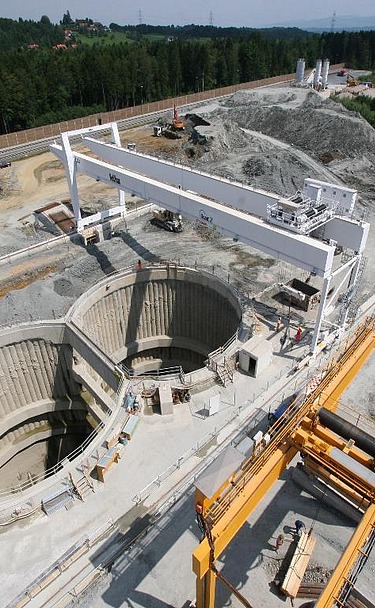
STRABAG was responsible for the KAT 2 contract section, covering the central part of the tunnel system. Construction was carried out from a single access shaft approximately 60 metres deep. The project combined conventional tunnelling methods in the sedimentary formations of the southern Graz Basin with mechanised excavation in the hard crystalline rock of the Koralpe using two double-shield tunnel boring machines with a diameter of 10 metres.
A particular feature of the project was the sustainable use of excavated material. The rock excavated during tunnelling was processed directly on site and reused for the production of tunnel lining segments and concrete aggregates. In total, materials for approximately 1,1 million cubic metres of concrete were produced from the excavated rock.
Since the opening of the Koralmbahn in December 2025, travel times have been reduced from around three hours to approximately 45 minutes. This is significantly improving passenger mobility and freight transport capacity in southern Austria.
Scope of Work
- Construction of more than 20 km of twin-tube railway tunnels
- NATM and TBM methods
- Operation of two double-shield tunnel boring machines
- Construction of a 900 m long underground emergency stop station
- Works under challenging geological conditions - sedimentary and crystalline rock formations